Last Thursday, April 28, the online conference “Sustainable school food: global challenges, local solutions” was held, which reflected on how to create healthier and more environmentally friendly school menus through global and local experiences. Catch up on the full lecturehere.
Last Thursday, April 28, the online conference “Sustainable school food: global challenges, local solutions” was held, which reflected on how to create healthier and more environmentally friendly school menus through global and local experiences. Catch up on the full lecturehere.
How can we create a More sustainable food system through school canteens?, what practices are being carried out around the world and in Catalonia to face this challenge? These were some of the questions that were posed in the online conference “Sustainable school food: global challenges, local solutions”, framed within the European project Parem Taula pel Clima.
The first part of the evening, led by the director of innovation and content of Fundesplai, Carles Xifra, featured presentations by experts from around the world. The director of the Global Research Consortium For School Health and Nutrition, Donald Bundy, contextualized the need for food programs in schools and their great impact on the development of children and young people from 2 to 20 years old.

Image: Colloquium moderated by the director of innovation and content at Fundesplai, Carles Xifra, with international experts Donald Bundy, Geraldine Gibert and Cecilia Rocha.
The representative of the organization Forum For The Future, Geraldine Gibert, stressed the importance of rethinking the current food model, since it is one of the responsible for a large part of the emission of greenhouse gases: “we cannot combat climate change without changing our agricultural model”. Through her experience working in the United States with Forum For The Future, she presented some of the practices carried out in school meal programs, which called for reducing the intake of animal products and the incorporation of more vegetable protein.
The person in charge of closing the block of international interventions was Cecilia Rocha, member of the International Panel of Experts on Sustainable Food Systems. Rocha explained the current national school meals program in Brazil, created in 1955 and which, currently, offers meals to more than 42 million students in public schools. In addition, he also stressed the great importance of creating menus based on local products to contribute to the reduction of the environmental impacts of school meals, and also the need to institutionalize food and consider it a public good.
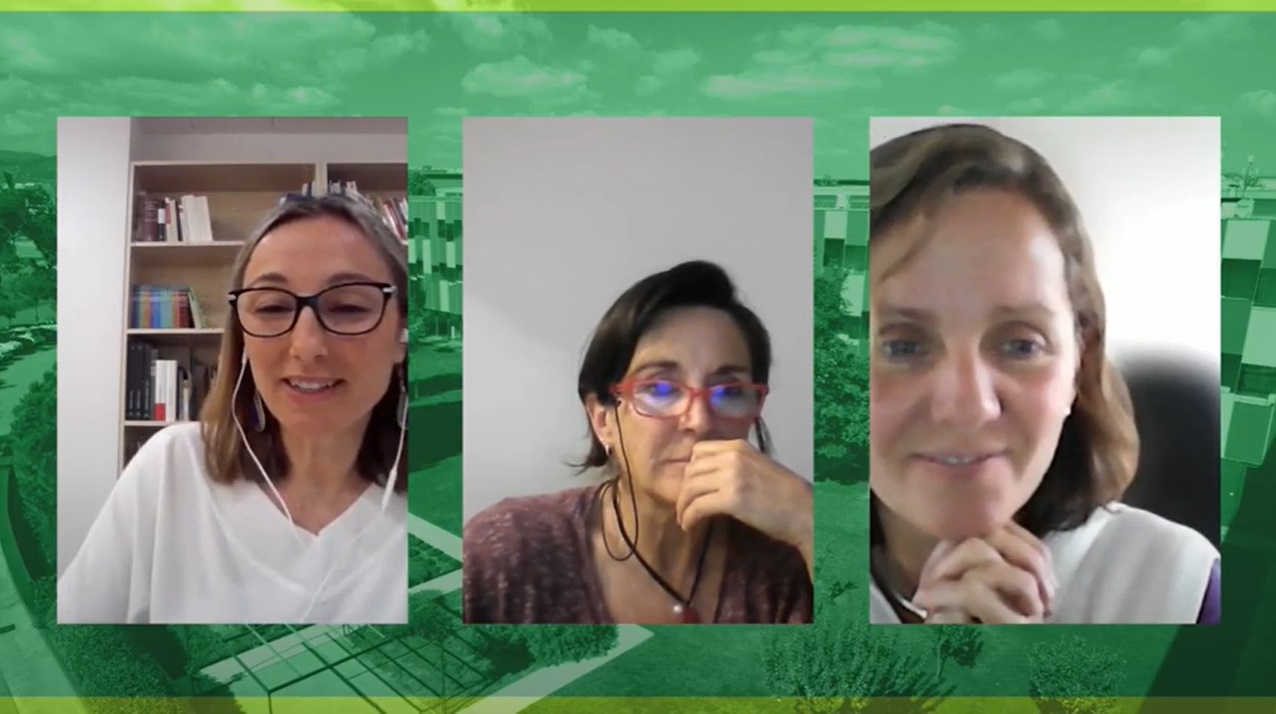
Image: the round table “Local perspectives for global challenges” counted with the participation of Gemma Salvador from ASPCAT; and Lidón Martrat, operational coordinator of Barcelona World Capital of Sustainable Food 2021.
The second part of the event featured the round table “Local perspectives for global challenges”, moderated by Fundesplai pedagogue Susagna Escardíbul, and led by Gemma Salavador, representative of the Public Health Agency of Catalonia (ASPCAT) and Lidón Martrat, operational coordinator of Barcelona World Capital of Sustainable Food 2021. The objective of the round table was to expose the approaches and experiences that are promoted from Catalonia to accompany the community of school canteens in the transition towards more sustainable food systems.
Some of the practices that were highlighted were the increase in the presence of fresh and local products in Catalan canteens and the promotion of vegetable protein in the consumption of red meat. The main conclusions drawn were the need for a change of narrative that empowers children in their food choices, through joint work with families, the educational world, catering professionals and institutions.
About the Parem Taula pel Clima project
The European project “Parem Taula pel Clima” is made up of a cycle of conferences that invite the audience to learn and reflect on our current food systems, as well as to participate and act for their necessary transformation.
The NGOs associated with the project are Fundesplai, Umanotera (Slovenia) and Fifty-Fifty (Greece).
Activity belonging to the EUKI project “Parem Taula pel Clima”.
This project is supported by the European Climate Initiative (EUKI) of the Federal Ministry of Economic Affairs and Climate Action of the Government of Germany.