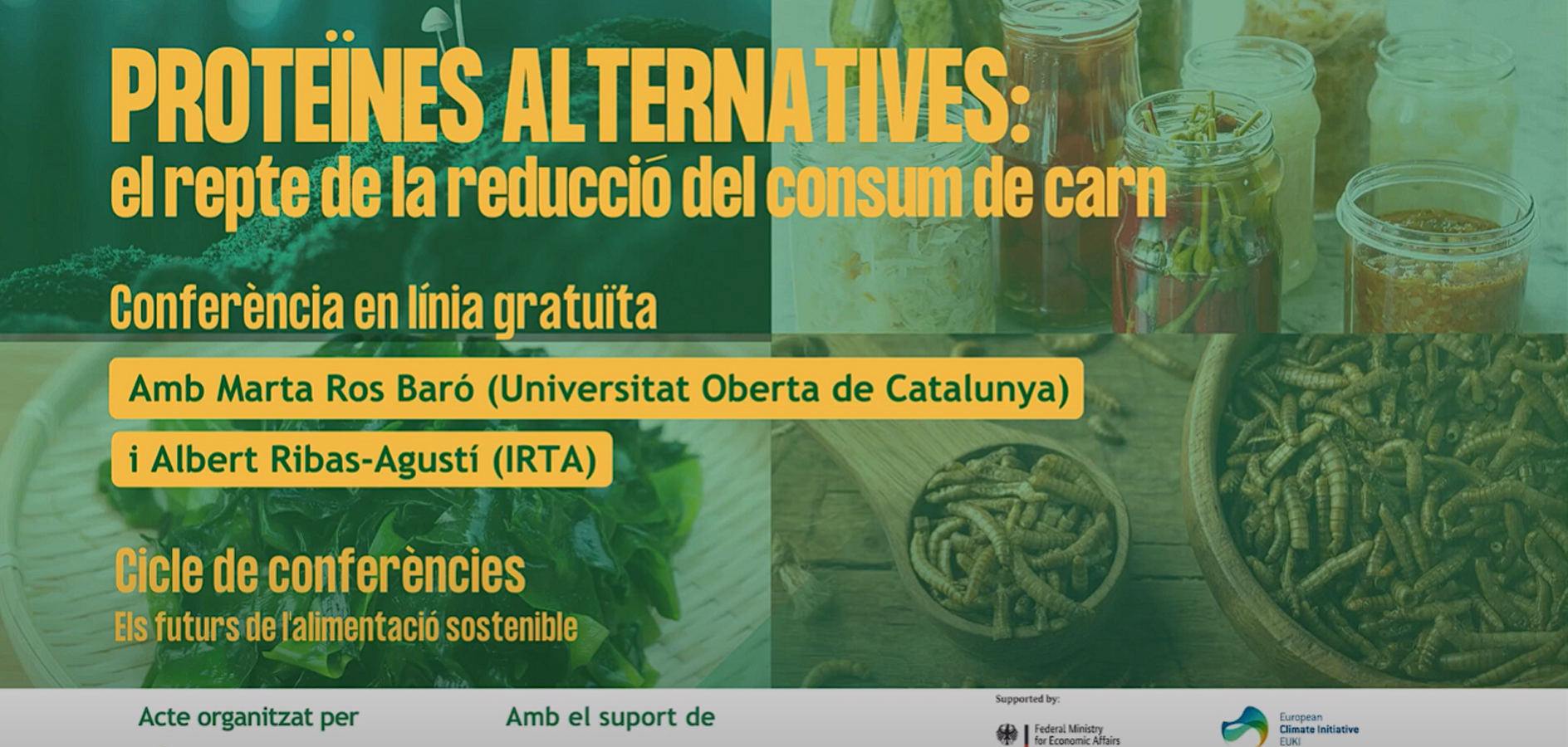
Last Tuesday, January 31, the EUKI project “Parem Taula pel Clima” ended its cycle of conferences with a talk on alternative proteins to meat consumption. You can catch up on the talk here.
Last Tuesday, January 31, the EUKI project “Parem Taula pel Clima” ended its cycle of conferences with a talk on alternative proteins to meat consumption. You can catch up on the talk here.
- English version.
The conference presented four examples of alternative protein sources to meat consumption, as well as its viability in the market and the benefits that its consumption may mean in the diet of the future.
The researcher of the Food Functionality and Safety Program of the Institute of Agrifood Research and Technologies (IRTA), Albert Ribas-Agustí, focused his intervention on the exposure of three types of protein sources: “plant-based”, originated from cereals or plants, algae and microalgae, and microbial, arising from the fermentation of fungi, yeasts and bacteria.
Ribas-Agustí presented several examples of products derived from these proteins, such as vegetable meats and milks, tempeh or energy bars. In addition, he also presented new foods that are being developed in research projects led by IRTA, such as vegetable creams combined with microalgae, which have turned out to be a product rich in protein and with more than 20% caloric value.
The second part of the day featured Marta Ros Baró, food technologist and professor at the Open University of Catalonia, who addressed the scenario of edible insects as a source of alternative protein. Baró highlighted the nutritional benefits of insects, which could be included in the food pyramid on the same level as legumes.
The food technologist also reflected on the food taboo involved in the consumption of insects in various societies, and the various social and cultural obstacles to their acceptance. However, Marta Baró explained several keys to its entry into Western food, such as introducing it as flour or formulating it in foods close to local cuisine.
Marta Ros also cited data from the World Bank, which warns that the human population will increase by 9 billion in 2050 and that this will mean having to produce 50% more food. Insect consumption, therefore, could be a solution to address food shortages.
The EUKI project “Parem Taula pel Clima” says goodbye
The activity, framed within the cycle of conferences The futures of sustainable food, has closed the set of talks of the EUKI project “Parem Taula pel Clima”.
The program, promoted jointly by Fundesplai and the associations Umanotera, from Slovenia, and Fifty-Fifty, from Greece, has worked to encourage the population (especially young people and adults), to make more informed and responsible food decisions, offering gamified and participatory activities.
Activity belonging to the EUKI project “Parem Taula pel Clima”.
This project is supported by the European Climate Initiative (EUKI) of the Federal Ministry of Economic Affairs and Climate Action of the Government of Germany.