Civil society plays a key role in transforming food systems towards more sustainable models. Shortening the circuits between production and consumption, promoting local and seasonal products or promoting organic farming are some examples of how these changes are being promoted. These were the main themes of the conference “The role of civil society in the making of sustainable food systems”. The keynote speaker was Peter Schmidt, President of the Agriculture, Rural Development and Environment (NAT) section of the European Economic and Social Committee. Catch up on the conference here.
Civil society plays a key role in transforming food systems towards more sustainable models. Shortening the circuits between production and consumption, promoting local and seasonal products or promoting organic farming are some examples of how these changes are being promoted. These were the main themes of the conference “The role of civil society in the making of sustainable food systems”. The keynote speaker was Peter Schmidt, President of the Agriculture, Rural Development and Environment (NAT) section of the European Economic and Social Committee. Catch up on the conference at this link.
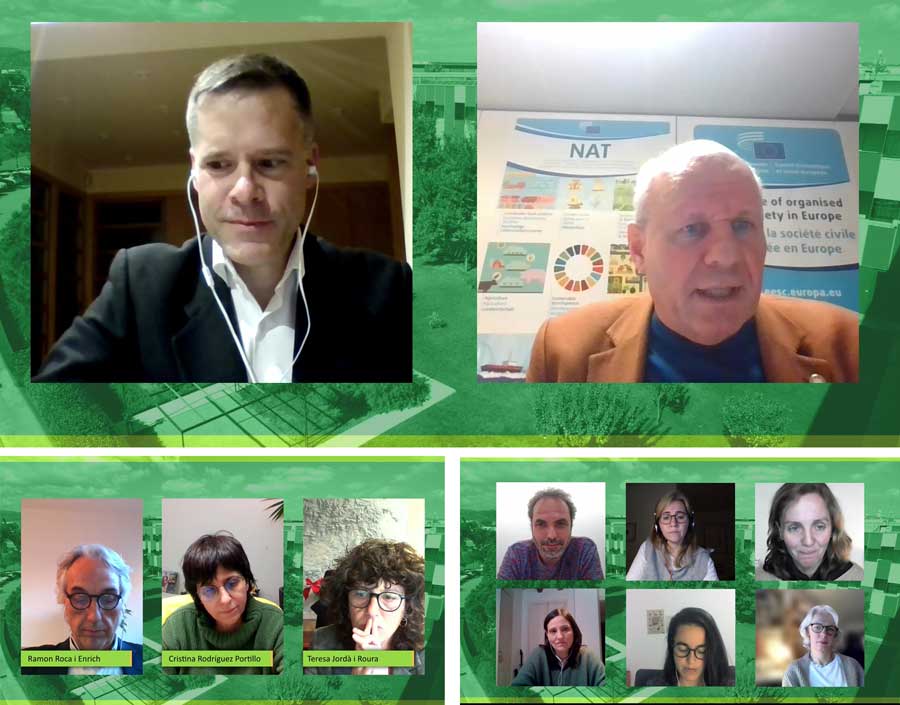
During the session, Schmidt highlighted initiatives from society that strengthen the links between producers and consumers and boost the local economy as one of the ways that can contribute to making food systems more sustainable. In addition to Peter Schmidt, Ramon Roca, president of the Advisory Council for Sustainable Development (CADS); Cristina Rodríguez, CEO of Fundesplai; and Teresa Jordà, Minister of Climate Action, Food and Rural Agenda of the Generalitat.
In these initial interventions, Roca highlighted the need to advance in the drafting of the National Food Policy Pact that sets strategic objectives for the future food system; Rodríguez explained how Fundesplai promotes the change towards healthier and more sustainable eating models in different educational spaces (schools, youth centers, summer camps, etc.); Finally, Jordan highlighted: “We work tirelessly to make the Catalan agri-food system sustainable, transformative and based on the circular bioeconomy”.
The conference also presented different examples of initiatives that have food sustainability as a central axis: the Catalan Food Council, the Food Charter of the Metropolitan Region of Barcelona, the Strategy to guarantee the right to food of Manresa, the initiative Territori de Vincles de la Vall del Corb, and the Food Council of the municipality of Ede. in the Netherlands. These entities shared their experiences regarding citizen participation. The attendees showed great interest in these testimonies and asked many questions and contributions.
The conference was co-organized by CADS and Fundesplai, with the support of the European Climate Initiative (EUKI) of the Federal Ministry of Economic Affairs and Climate Action of the Government of Germany.
Activity belonging to the EUKI project “Parem Taula pel Clima”.
This project is supported by the European Climate Initiative (EUKI) of the Federal Ministry of Economic Affairs and Climate Action of the Government of Germany.