You can now watch the video summary of the celebration!
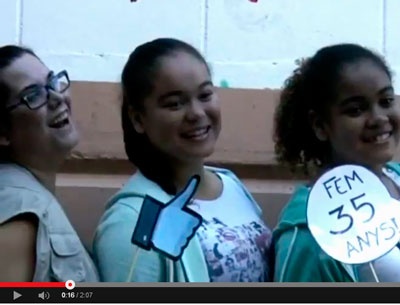 |
| You can now watch the video summary of the celebration |
 |
| Video of the history of the 35 years of the entity |
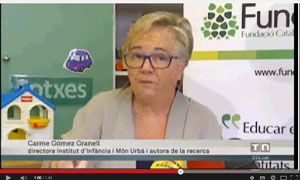 |
| TV3 News about the Club d’Esplai Pubilla Cases Can Vidalet 17/10/2014 |
|
| TV news L’H of the 35th anniversary of the Club d’Esplai Pubilla Cases Can Vidalet and research of CIIMU (from minute 4) |
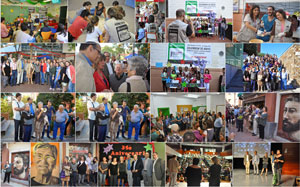 |
| You can now see the photo album! |
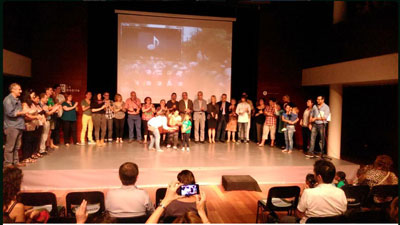 |
| The institutional event was attended by representatives of the institutions, children, families and monitors |
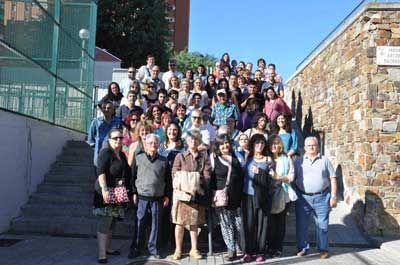 |
| Image of the visit to the different establishments of the esplai |
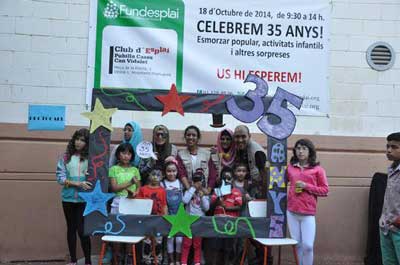 |
| Children, families and recreation monitors |
The Club Esplai Pubilla Cases – Can Vidalet (Hospitalet – Esplugues de Llobregat) celebrated its 35th anniversary on Saturday 18 October with a day full of events that began with a popular breakfast in the Plaça de la Bòbila. This esplai is one of the 65 leisure entities integrated into Fundesplai (Fundació Catalana de l’Esplai) and hosts about 700 children and young people from Pubilla Cases and Can Vidalet, two neighborhoods strongly impacted by the crisis, which host 35% of foreign-born residents.
The Club Esplai Pubilla Cases – Can Vidalet is an entity that opens all year round, from Monday to Saturday. This year, it has even opened during the month of August, in which it has organized a summer camp to guarantee the attention and food of about a hundred children in situations of social vulnerability.
Saturday’s day, which was guided by Carles Barba, president of CE Pubilla Cases – Can Vidalet, began with a popular breakfast and had its key moment with an act of recognition to Gregòria Ochoa and Vicenç Arias, two people who were fundamental in the development of the entity, which was followed by the institutional act.
Throughout the program of events on Saturday, different institutional representatives participated, such as the mayors of L’Hospitalet and Esplugues de Llobregat, Núria Marín and Pilar Díez, respectively; Celestino Corbacho, deputy for the PSC in the Parliament of Catalonia and former mayor of L’Hospitalet; Anna Simó, deputy for ERC in the Parliament of Catalonia; Ramon Terrassa, Director General of Civic and Community Action of the Government of Catalonia. The day, in addition, had the participation of different councilors of the municipalities of L’Hospitalet and Esplugues de Llobregat.
In addition, during the institivional event, Núria Valls, deputy director of Fundesplai, gave a silkscreen print with the pineapple, symbol of stity, to Ricard Vicente and Sheila Beltrán, director and deputy director of CE Pubilla Cases – Can Vidalet, in recognition of their work.
The day ended with the performance of a children’s animation group.
CIIMU study on the impact of recreation
Coinciding with the celebration of its 35th anniversary, the Institute of Childhood and the Urban World (CIIMU), the leading research centre on children and families in Catalonia, has carried out research to assess the impact of recreation on the people who participate in the entity. The study was presented on Thursday, November 16 by the director of CIIMU, Carme Gómez-Granell, and the director of the Esplai Pubilla Cases Can Vidalet de Fundesplai, Ricard Vicente.
For Gómez Granell, the main conclusion of the research “is that recreation has an extraordinarily positive impact on three dimensions: children, families and the community”. According to the director of CIIMU, ” it is a virtuous triangle because each dimension is connected and feeds back the other”
Thus, a 92% of the families appreciate that the boys and girls have improved in autonomy and self-confidence since they go to recreation; around a 80% They affirm that they are now more respectful, supportive, cooperative and tolerant and a 53,3% They claim that have improved in school performance (53.3%).
In the family environment, 77 % value that recreation solves an issue of reconciliation of work and family life, and another 70% highlight the learning, habits and values that their children incorporate thanks to recreation.
Regarding the relationship with the community, the study resolves that recreation becomes a space for welcoming and relating to many families, often single-parents, which allows them to share in better conditions the challenge of raising and educating their children. For Gómez Granell “the space for socialization and participation in community life is also accompanied by the incorporation of better tools for positive parenting and an improvement of the framework of intra-family relationships. Recreation becomes a tool, a node for creating networks and social cohesion in the neighbourhood”.