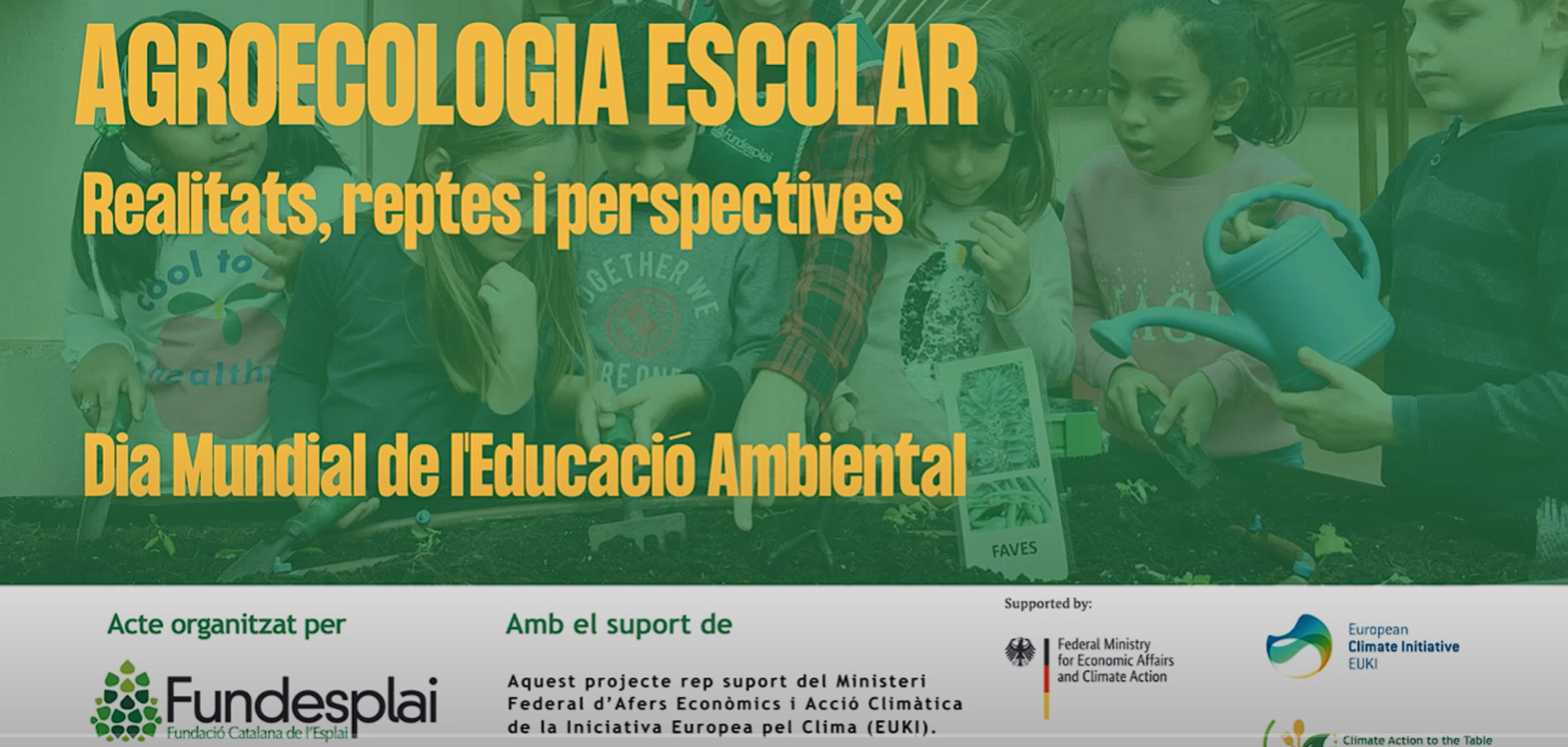
Last 26th of January, World Environmental Education Day, the EUKI project “Climate Action to the Table” organised the talk “School Agroecology: realities, challenges, and perspectives”. You can retrieve the talk at this link.
Last 26th of January, World Environmental Education Day, the EUKI project “Climate Action to the Table” organised the talk “School Agroecology: realities, challenges, and perspectives”. You can retrieve the talk at this link.
The first part of the event featured the participation of Germán Llerena, an environmental educator from the Environmental Department of Sant Cugat Town Council. His talk, entitled “Beyond the vegetable garden”, focused on the importance of incorporating agroecology into the educational plan of a school and the need to bring farming into schools.
In this sense, Llerena presented two of his books (written in collaboration with other authors), which include examples of schools or organisations currently practising agroecology in Catalonia. The publications are “Agroecologia escolar” (Polen Ediciones, 2017), which can be downloaded free of charge; and “Land of apprenticeships. Twelve beautiful stories for school agroecology in Catalonia“, which will be available later this year.
Some of the projects mentioned by Germán Llerena were that of Paidós and Fundesplai, which focuses on supplying organic food from the Collserola countryside to school canteens; We eat saints, promoted by the Institut Sants secondary school, which has managed to create an Organic Consumer Cooperative within the school; and that of the School April 21 school, from La Aldea (Tarragona), which has devised an Organic School Garden that studies the differences with conventional agriculture in the village.
Montse Escutia, an agronomist specialising in organic agriculture and coordinator of training activities for the Associació Vida Sana, closed the event. Escutia presented several educational resources for working at schools on the eleven axes that make up sustainable food: organic production, organic and extensive livestock farming, sustainable fishing, local consumption, seasonal food, short chains, fair trade, food safety, waste reduction, food waste and a healthy and sustainable diet.
Some of the materials presented to work on the said areas were those of the Stop Wasting Food project, promoted by Fundesplai and focused on food losses and waste; the School Canteen Season Calendar, by the NGO Food Justice; the video-story The plant war and the lost tomato, by the Encinar School, focused on working on a healthy diet; and Correlation, an educational proposal by the schools of Alt Empordà to collect food waste.
The event also featured the participation of Luciana Lerho, consultant of the EUKI project “Climate Action to the Table”. Lerho highlighted the aims of EUKI, an initiative promoted by the German Federal Ministry for Economic Affairs and Climate Action since 2017. Its main goal is to improve intra-European cooperation on climate protection and green transformation.
With more than € 70 million of funding, the programme has implemented 179 projects involving more than 300 organisations across the European Union. Other objectives of the EUKI programme are to strengthen the role of civil society in climate action at regional, national and European levels and to create networks for the exchange of good practices.
The EUKI consultant presented two successful projects in line with the theme of the event: ” Clikis ” and ” Clikis Network”, developed in Germany, Poland, Croatia and Estonia. Both programmes, now completed, focused on making catering systems more environmentally friendly, considering both healthy and seasonal food and energy savings in school kitchens.
Activity comprised in the EUKI project “Climate Action to the Table“.
This project is funded by the European Climate Initiative (EUKI) of the German Federal Ministry for Economic Affairs and Climate Action.