
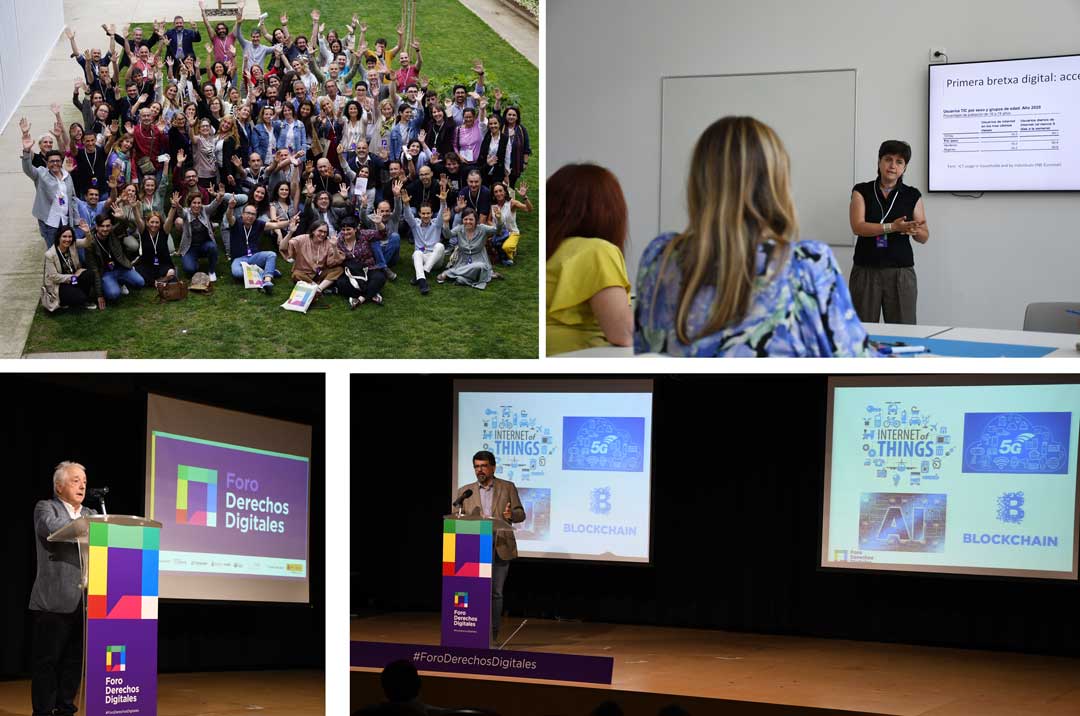
At theRed Conecta and Fundesplai Platform conference that took place in Centre Esplai.
Thursday 26 May, the Red Conecta Platform and Fundesplai welcomed the Digital Rights Forum, an event that brought together nearly 300 facilitators and dynamizers of digital inclusion centers of the Third Sector, political representatives and the business sector to reflect and share proposals that contribute to guaranteeing the digital rights of citizens. The main conclusion of the Forum is that digitalisation, accelerated by the pandemic, must be a space that guarantees equal rights and social transformation and avoids the growing risks of exclusion posed by the lack of digital skills and connectivity on the part of citizens.
According to the Digital Spain Report 2025 (2022 ), almost half of Spanish citizens do not have basic digital skills. In an environment in which 90% of jobs require basic digital skills, in Spain 36% of employees do not have these skills, and 8% of Spaniards have never used the Internet. According to the Ospi Report on the Gender Gap (2022), it is estimated that women are three percentage points below the percentage of men in terms of knowledge in digital skills. Only 1.4% of ICT specialists are women.
The main networks that address digital transformation and work on overcoming digital divides at national and European level participated in the forum: Red Conecta Platform, Fundación Esplaiand Somos Digital association at the state level and ALL DIGITAL at European level.
The day began with an institutional welcome where Josep Gassó, president of Fundesplai, who highlighted: “Centre Esplai, our headquarters in El Prat de Llobregat, becomes a space for all people committed to changing the world and these days this is being done combating the digital divide”. Subsequently, he intervened Enrique Arnanz, president of the Board of Trustees of Fundación Esplai, who highlighted that the fight for digital rights is an ethical and democratic issue: “Today not having access to technological devices is a problem of public dignity, because new technologies are key in our habitat. These are essential rights today to be citizens.”
Altheo Valentini, president of ALL DIGITAL, highlighted the current context: “We are living in a unique moment, because we are the only generation that has the opportunity to lead digital transformation in a way that can have a beneficial impact on society”. Antonio Ibáñez, president of Somos Digital, wanted to give relevance to the work of digital competence centers “fundamental to achieve an increasingly digital citizenship and seek the defense of digital rights by working directly on the needs of citizens”.
Ángela Caballero, president of Plataforma Red Conecta, dedicated her words to networking between the different agents that make the application of digital rights possible: “We work so that digitalization is not just another process of exclusion for citizens”. He also defended the need to gain space and advocacy, especially in the political sphere.
Shortly afterwards, Genís Roca, an expert in Internet, culture and digital transformation, gave a lecture on digital rights where he outlined a timeline of the transformation that society is experiencing towards a digital society. “It is a process that began in the 80s and is still developing, surely our generation will not see it completed. It began with centralized computing, the first telephony standards, the emergence of programs that improved processes; it goes through PCs, the emergence of the Internet, mobile networks (3G, 4G and 5G) and smartphones until now of Artificial Intelligence, Big Data, the Internet of Things, etc. where data plays a central role”. Roca explained: “We are now at a time when massively personalized data is being used in real time and we must be very strong in the fight for people’s digital rights, since this new situation affects the rules of the game and people’s identity”.
Workshops on gender equality, sustainability, childhood… in the digital sphere
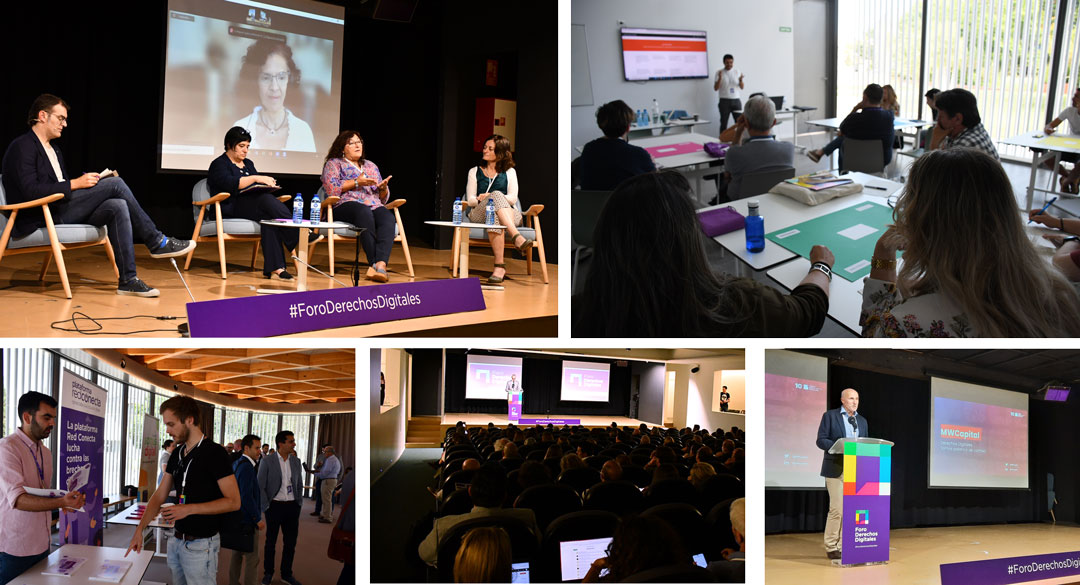
After the opening session, the nearly 300 attendees were divided into 12 simultaneous workshops to debate and generate proposals around Equality and non-discrimination: Gender; Protection of children and youth; Access gaps: Ruralities; Environmental impact and sustainability; Employability; Digital education for social inclusion; Equality and non-discrimination: migrants; Universal accessibility: people with disabilities; Internet governance and citizen participation; Digital skills for employability; Artificial intelligence.
In the last part of the morning, a fair of entities (Marketplace) was held where projects and initiatives of the different participating entities were presented.
The afternoon event was attended byAnna Romeu, vice-president of Fundesplai, who gave this forum as an example as a strategic alliance for the defense of the rights of vulnerable people in the digital field; from David Vicioso, deputy mayor of the City Council of El Prat de Llobregat, who indicated that the main challenge of digitalization is to expand rights and not reduce them, and David Ferrer i Canosa, Secretary General of Digital Policies of the Generalitat de Catalunya, who highlighted that the public administration works to reduce the social, economic and connectivity gaps that make up the digital divide; Carme Artigas, Secretary of State for Digitalization and Artificial Intelligence, ended the afternoon’s presentation by stating that all rights must be transferred to the digital environment in order to have a fair and inclusive digitization.
Presentation of the book “Reimagining the present to reduce digital divides”
The Forum also included the presentation of the book “Reimagining the present to reduce digital divides” in the form of a round table with experts in digital transformation by Clara Centeno, researcher at the Joint Research Centre of the European Commission; Cristina Colom, director of Digital Future Society at Mobile World Capital Barcelona; Nuria Salán, president of Catalan Society and Technology; and Núria Valls, general director of Fundación Esplai and director of the Red Conecta Platform. Centeno made an analysis of the digital situation of the labor market that highlights that while 82% of jobs require digital skills, there is 32% of the active population that does not have these skills and stressed that new trends (artificial intelligence, big data…) can still lead to greater digital exclusion; Columbus defended the need to foster and protect the rights of people who lack connectivity; along these lines, Valls abounded: “technology must be a space for equality and not exclusion and must be a space for social transformation”; Finally, Salán focused her speech on the need to promote female role models in the world of technology: “it is necessary to introduce technology into the contents of the school with passion and references from close women” in order to contribute to the promotion of scientific vocations among girls.
At 6:15 p.m. the conference “The importance of strategic alliances for Digital Rights” was given by Carlos Grau, CEO of the Mobile World Capital Barcelona Foundation and patron of Fundesplai. Subsequently, the last round table was held moderated by Chus Lago, with Joana Barbany, general director of Digital Society of the Government of Catalonia; Gerardo Franco, director of Microsoft Philanthropies in Western Europe; Alejandra Solla, executive director of La Liga Iberoamericana de las Organizaciones de la Sociedad Civil, and Altheo Valentini, president of ALL DIGITAL.
The Digital Rights Forum aims to take on common challenges and responsibilities between Third Sector entities, political representatives and the business sector to overcome digital divides and claim access and use of technology as a right for citizens of the twenty-first century.