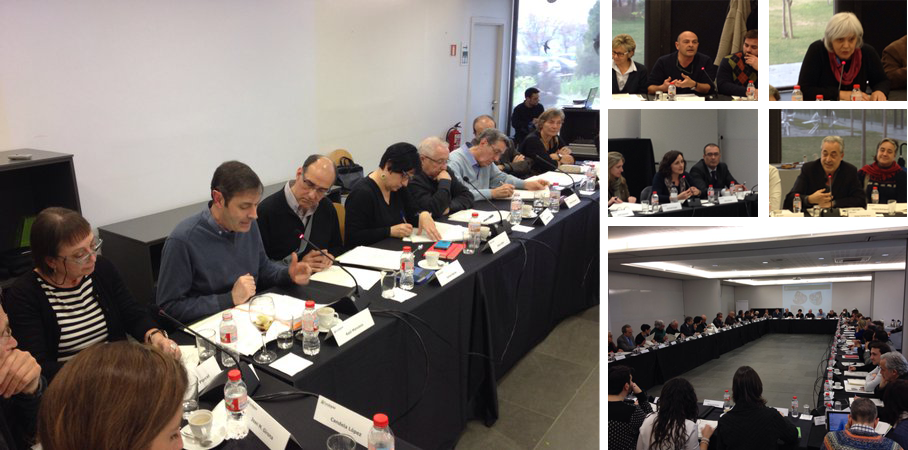
More than 60 people from different fields participated in the plenary session of the Fundesplai Advisory Council, held at CENTRE ESPLAI (El Prat de Llobregat).
 |
| CLICK ON THE IMAGE TO SEE ALL PHOTOS |
A new Advisory Board, expanded and renewed, held its plenary meeting on Wednesday, March 9, 2016 at CENTRE ESPLAI (El Prat de Llobregat)
| Complete list of Advisory Board |
The new council for the next four years has been expanded to 67 members and half of its members join for the first time. The new composition aims to reinforce its diversity from the sectoral point of view. Thus, people from the fields of communication and the environment have joined, greater plurality has been collected in the political sphere, and the representation of the municipal world, the economic world, the third sector and the educational and social world has been expanded.
The renewal has partially corrected the existing imbalances both in terms of gender, 40% are women, and at the territorial level, with the incorporation of more people from Girona and Lleida. Finally, the Council has been rejuvenated and, above all, integrates a generational diversity that provides complementary perspectives of great value.
Josep Gassó, president of Fundesplai, welcomed the attendees and gave way to Amparo Porcel, member of the Board of Trustees and Carles Barba, vice-president, who presented the new composition of the Advisory Board, which increases and renews part of its members. Later, Núria Valls, deputy director of the entity, reviewed the main actions of Fundesplai and Salvador Carrasco introduced the central presentation of the plenary session on “Social change and educational transformation”, which was given by Raül Manzano, teacher, Director of GUIX, member of the FMRP and the Advisory Board of Fundesplai.
Social Change and Educational Transformation
The interventions of Carrasco and Manzano placed the elements of change of era that our society is experiencing, the contradictions generated by the dominant economic, political and environmental logic, the panorama of uncertainties in which we live and the confusion of education.
They also noted, positively, the effervescence of innovative educational initiatives with a transformative vocation that are taking place.
This presentation closed with two questions that guided the debate among the attendees: What do we consider that we must educate to be good citizens? And, with a logic of networking and collaboration, what can and should each contribute to the educational strategy?
Interventions from different perspectives
The debate was very rich and, above all, diverse and complementary due to the origin and background of the participants such as Dolors Sabater and Lluís Tejedor, from the world of city councils, Josep Carles Rius from communication, Carles Grau from the business world and ICT, Quim Brugué and Ismael Peña, from the universities, Joan Girona and Elena Síntes, from the educational field, Xavier Masllorens and Fina Rubio, from the world of social organizations of Pau o la Dona, Jordi Menéndez, from the political field, or Frederic Ximeno, from the environment.
A great coincidence above the particular accents and prisms in the sense of the nuclear importance of transforming education as a strategy for change and the need to make this great challenge transversal beyond the school institution and that it becomes a tool for equity and citizen training in the broadest sense.
This session marked the beginning of a process of debate that Fundesplai wants to share with many others about the transformation of education.